Efficiency, accuracy, and smoothing operations are necessary in the modern industrial landscape to have efficient power transmission systems. Flat belt has also been a brilliant solution in realizing high-speed operation with little vibration, although there are other types of belts that are used in mechanical work. The simplicity of design, added with the use of high-quality materials and engineering modifications, enables them to provide consistent power transfer in the harsh industrial conditions. Flat Belts have been used in the automotive and textile industries for operations in which speed, stability, and energy efficiency are essential.
Understanding Flat Belts
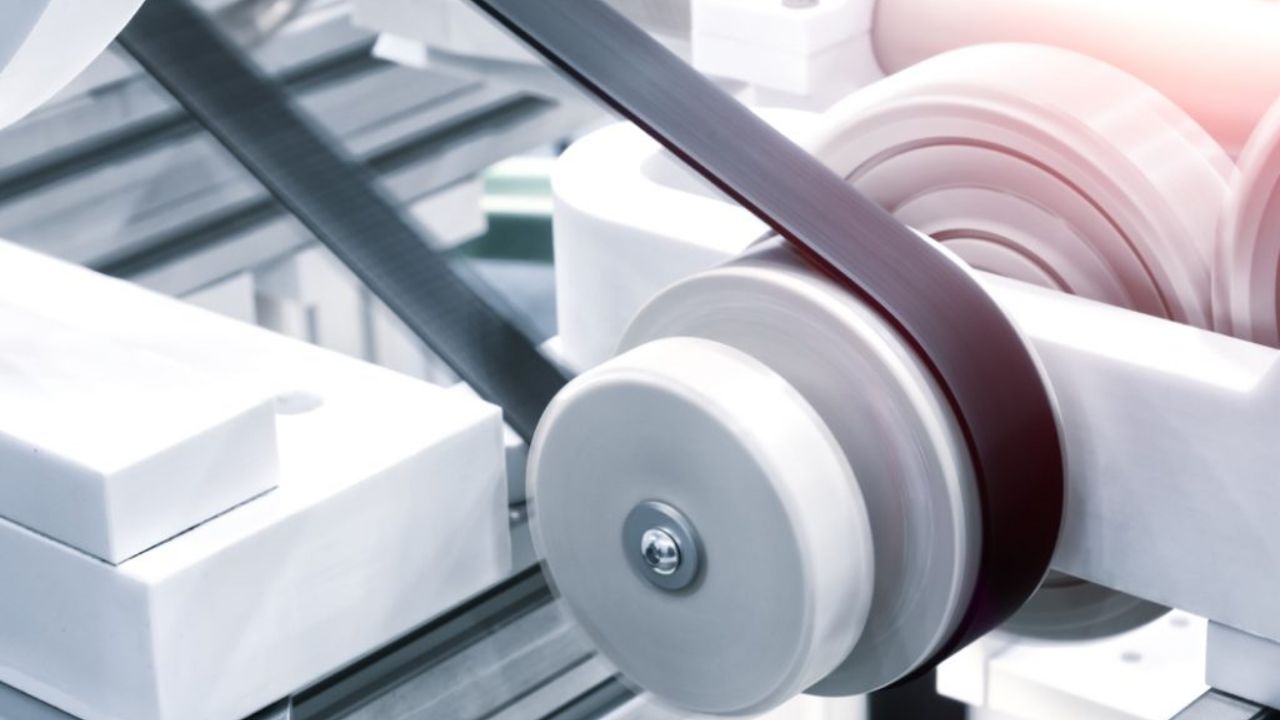
Flat belts are chemical-bonded, continuous, flexible belts that have a flat cross-sectional profile, normally composed of rubber, polyurethane, leather, or composite material, reinforced with textile or steel cords. The wide, flat surface, which conveys the power with friction between the belt and the pulley, is their characteristic feature. Surface contact, unlike timing belts that operate by running on teeth, enables flat belts to be flexible and operate at higher speeds.
Their design is very simple, therefore making them lightweight and efficient, and the use of modern materials increases durability and reduces slip.
Power Transmission Capabilities and High Speed
Among the greatest benefits of the flat belts is the fact that they are able to work at a high speed. Their lightweight and elastic form enables them to easily interact with pulleys and minimize the loss of energy (because of friction or inertia). Flat belts do not need the meshing effect of the toothed belts and thus can be used in high-speed machinery without producing vibration and noise.
Flat belts are used in industrial processes like paper mills, textile manufacturing lines, and packaging lines to ensure that there is continuous movement with high rotational speed and do not overheat or wear too much. The broad area of contact evenly distributes the load, and the stress on the belt and the pulley is not localized. This uniform distribution of loads also prevents slipping, enabling steady transmission of torque even under high RPMs.
Low-Vibration Operation
In any power transmission system, vibration is one of the key issues that may cause energy loss, mechanical wear and tear, and even shortened equipment lifespan. Flat belts solve this problem because they fundamentally have the capability of absorbing shock as well as damping vibrations. The flat and flexible design of the belt gives a cushioning effect and therefore reduces the number of oscillations that usually accompany high-speed rotation.
The constant contact of the belt and pulley is smooth, eliminating noise and the mechanical resonance that may destroy the bearings and shafts. Consequently, the machines with flat belts are less noisy and have fewer mechanical loads. This low vibration performance is particularly useful in industries where success is measured in accuracy, such as printing and electronic manufacturing, where error-free motion control has a direct influence on product quality.
Energy Saving and Cutting Maintenance
Flat belts are also energy efficient. Their power transmission system is based on friction, which makes minimal internal losses, which means that more energy is transferred straight between the driving and driven components. They are also flexible and lightweight, and as such, do not need as much tension as other types of belts, hence minimizing bearing loads and general energy consumption.
There are also very few maintenance needs because flat belts produce less heat and have low wear rates as compared to conventional V-belts.
Generalized Uses of the Contemporary Industry
Flat belts are commonly employed in numerous industrial and mechanical applications because they are versatile and reliable. They are applied in manufacturing, to move conveyors, milling machines, and automated assembly systems, which need to move smoothly, faster, and efficiently. Flat belts are used in the automotive industry in auxiliary drives and test benches, which require precise control of speed.
Flat belts are also useful in the textile and printing industry since they can perform their function of running quietly and efficiently at high speeds. They are operated smoothly, which makes them consistent in handling their products, making the quality of production better. Besides, flat belts can be used in energy-saving drives in the HVAC systems, fans, and compressors, where quiet and low-vibration operation is strongly appreciated.
Conclusion
The reason why the flat belts have been a key element in the power transmission technology is because of the incredible combination of high speed, low vibrations, and efficiency in operation. By providing consistency of power delivery, they increase the performance and life of the machinery and minimize the expenditure of maintenance. They are adaptable and reliable in the engineering field, which is shown by their flexibility in the industries, both heavy industries and precision equipment.