The most common issue when bending long workpieces is angle inconsistency between the center section and the ends. This is typically not due to a problem with the machine’s accuracy, but rather the result of deflection, unstable tooling assembly, lack of support, improper selection of the V-die opening, or material variations. This article will explain the logic behind crowning and analyze other factors that affect angle inconsistency along the entire length of long workpieces.
First, determine whether this is a machine issue or the normal load behavior of long workpieces
Why short workpieces are fine, but long workpieces start showing deviations right from the start
Even with the same machine, the same material, and the same program, the load distribution can change simply because the bending length is different. The challenge with long workpieces lies in maintaining consistent stress distribution along the entire length; therefore, the longer the workpiece, the more pronounced the deflection of the machine frame, table, and tooling becomes, leading to greater angular deviations.
What do “larger in the middle, smaller at both ends” or “larger at both ends, smaller in the middle” indicate?
More open in the middle (larger angle values), tighter at both ends (smaller angle values): This is typically caused by insufficient crowning. In other words, the actual stress on the machine frame, table, and tooling exceeds the current crowning value.
More open at both ends and tighter in the middle: This is typically caused by excessive crowning. It is commonly observed when bending thin sheets or short workpieces on high-tonnage, long-bed machines, where the crowning value exceeds the actual stress on the machine frame, table, and tooling.
Which variables are most likely to amplify angular deviations along the entire length
Bending length, load distribution, and total tonnage
Deflection of the machine frame, table, and tooling is primarily influenced by the bending force. The longer the workpieces, the greater the load on the equipment, and the more uneven the load distribution, the more pronounced the deflection of the machine frame, table, and tooling becomes, resulting in larger angular deviations along the entire length of the workpieces.
An excessively small V-die opening, material variations, and batch differences
Many people assume that angle inconsistencies along the entire length of long workpieces are caused by equipment precision issues, but in reality, an excessively small V-die opening, as well as fluctuations in material strength and thickness, can also cause angle variation. The smaller the V-die opening, the higher the bending tonnage typically required, and the more pronounced the deflection of the machine frame and table under load; meanwhile, variations in material thickness, strength, and springback affect the stability of the angle along the entire length. If the material itself exhibits thickness or strength inconsistencies along the bend line, it will cause different degrees of deformation in different sections during bending, thereby making the angular deviation across the entire length even more pronounced.
What exactly does the crowning address, and what can it not solve?
Differences between manual shim correction, mechanical crowning, hydraulic crowning, and CNC-controlled crowning
Manual shim correction: Temporary shims are added to specific areas of the lower die to correct for deflection, but this method is only effective for specific parts. This approach relies heavily on the experience of skilled technicians, requires frequent trial and error, and does not achieve high precision.
Mechanical crowning: Uses wedges or similar structures to create a reverse curve that closely matches the actual machine deflection, providing precise crowning across the entire length of the table, with higher accuracy and repeatability.
Hydraulic crowning: Uses hydraulic cylinders beneath the table to create a crowning curve that lifts the table. Generally, the more cylinders there are, the higher the system’s accuracy; however, specific considerations must also be given to control methods and overall design. Furthermore, such systems are typically integral components of the machine tool and are difficult to retrofit later.
CNC-controlled crowning: The control system calculates and adjusts crowning values in real time based on program parameters, actual bending loads, or machine settings, making operation easier and typically improving repeatability.
Why crowning isn’t as simple as turning a knob
Crowning can only correct the load-induced angle curve across the full length of a long workpiece. However, if the tooling itself is worn or the V-die opening is incorrectly selected, the crowning system will struggle to achieve the desired correction effect.
Tooling layout and support methods: why they affect the results of long workpieces
Segmented tooling, tooling joints, and uneven left-right load distribution
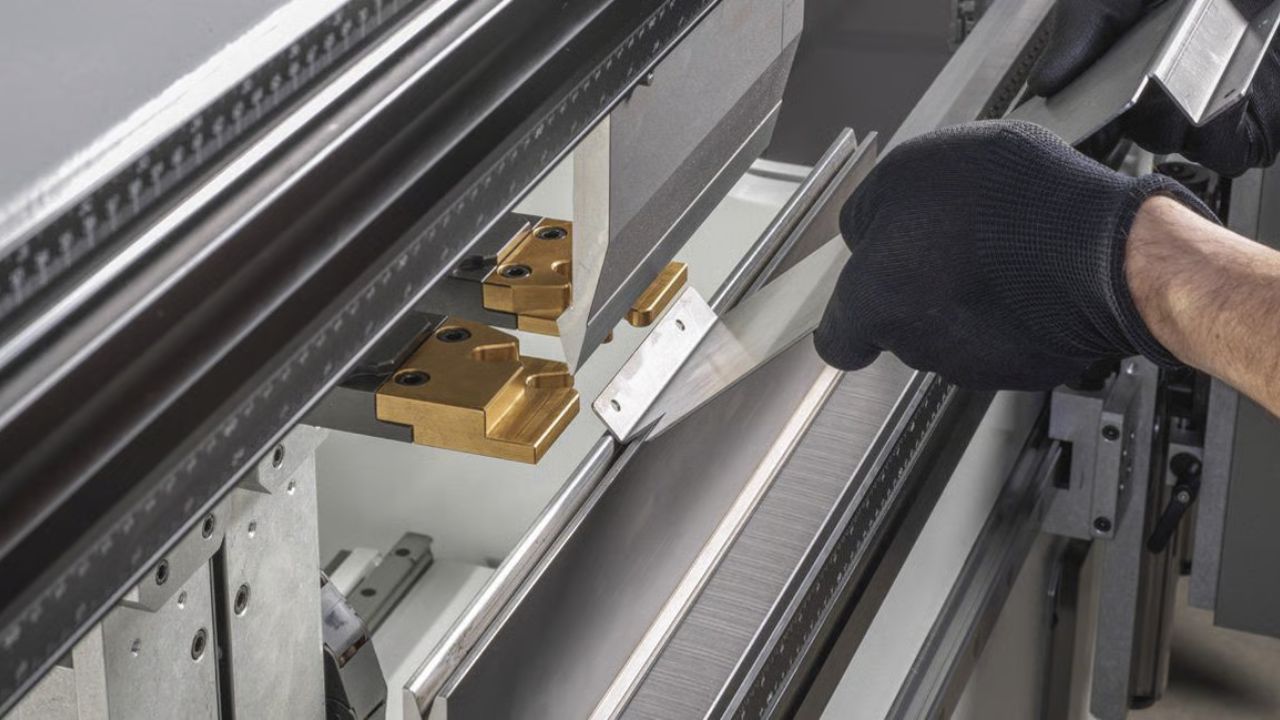
Bending long workpieces typically requires the use of segmented tooling. If the tooling heights are inconsistent, there are gaps at the joints, or there is uneven load distribution between the left and right sides, this can cause angle inconsistency in the bending process.
Sheet support, sheet followers, and consistency in manual handling
If a long workpiece sags due to its own weight or if the operator uses incorrect lifting or flipping techniques, angle consistency will be compromised. Therefore, the process relies heavily on the stability of support and handling. Sheet followers can reduce the operator’s workload, provide stable support for the workpieces, and improve angle consistency along the entire length.
What is the correct sequence for on-site troubleshooting?
Examine the material and test specimens first, then the tooling and crowning
When troubleshooting on-site, we can follow this sequence: First, confirm whether there are significant deviations in the material’s thickness and hardness → Check whether the correct V-die opening has been selected → Check whether the tooling assembly and clamping remain consistent along the entire length → Verify whether the support system or sheet followers are effective → Adjust the crowning value as needed.
If necessary, use short test specimens of the same material and thickness to perform trial bends at the left, center, and right positions, and compare the changes in bending angle.
Which data should be recorded to avoid starting from scratch each time?
For bending long workpieces, it is necessary to record data such as material grade, sheet thickness, bending length, lower-die V-opening, and crowning values, as these factors collectively affect the result across the full length.
What to focus on when purchasing or upgrading equipment for long workpieces
When comparing different press brake machine solutions, many buyers first focus on the machine’s tonnage and maximum bending length. However, when it comes to bending long workpieces, these most prominent parameters are often not what truly determines the bending result. What truly matters is the crowning method used, whether real-time angle measurement is available, the presence of support devices, and whether the tooling alignment and clamping remain consistent along the entire length. Therefore, to ensure consistent angles along the entire length of a long workpiece, the key is not the machine’s tonnage, but its ability to maintain consistency throughout the entire length.